September 28, 2026Journal entry
Picking the SoC: six chips in sixteen months
Two Allwinner chips, four Rockchip chips, and the one lesson that would have saved five months: prove the video path first.
By Andrew Douglass · Founder
Disclosure: Our articles contain affiliate links, including Amazon. If you buy through one, we may earn a commission at no extra cost to you, and as an Amazon Associate we earn from qualifying purchases. It never affects our testing, measurements, or verdicts. Full disclosure.
This picks up where the first entry left off.
The WarpKVM 02 ships on a Rockchip RV1126B, the sixth processor this product has been designed around, and a chip I did not know existed when I started. If you are picking an SoC for anything that captures video, the short version of this post is: the SoC decision is really a video-path decision, and you should prove the video path before you draw a schematic. Two of the six chips were Allwinner and four were Rockchip.
For clarity on the products: the WarpKVM 01 is the flagship, on the RK3576, built for 4K60 capture. The WarpKVM 02 is what started as the cheaper 1080p model, and it now captures 4K30 on the RV1126B.
Six chips took sixteen months, which sounds like a long time, so some context: for almost all of it this was a part-time project, nights and weekends around consulting work, and it only became my main focus this summer.
The scorecard
| SoC | When | Why it was picked | Why it was dropped |
|---|---|---|---|
| Allwinner T507 | May 2025, 3 days | Cheap, with 4K60 video and H.264 encode on paper | The part I could buy had no HDMI output, which passthrough needs |
| Allwinner A527 | May to Oct 2025 | About $11 at 100 units, dual Gigabit Ethernet, an open reference design | The RK628D capture bridge never worked on it |
| Rockchip RK3576 | Oct 2025 to now | Native RK628 support and 4K60 encode | Not dropped: it is the flagship chip |
| Rockchip RK3568 | Jan to May 2026 | Two Ethernet MACs for the 1080p model | A network switch made the second MAC unnecessary |
| Rockchip RK3566 | May to Sept 2026 | Cheaper than the RK3568 once the switch did the networking | The RV1126B does 4K30 for less |
| Rockchip RV1126B | Sept 2026 onward | Cheaper, 4K30 capture, and off-the-shelf boards run the same firmware | Final for the WarpKVM 02 |
The SoC prices below are rough figures a sourcing agent gave us at the time. The switch and RV1126B prices are distributor listings.
Allwinner, for cost
Three days to kill the first chip, then five months on the second without a single working frame. We started on Allwinner for one reason: it was much cheaper. You get what you pay for, as it turns out, but I did not know that yet.
The first pick was the T507. The pitch in May 2025 was a device with 4K60 HDMI out for passthrough and H.264 encode at 4K25, retailing for about $59. Three days after I ordered dev boards, I found out the version of the T507 I could actually source has no HDMI output. That ended it.
The A527 was the replacement. It cost about twice as much, roughly $11 at 100 units, but it added dual Gigabit Ethernet, which I wanted for daisy chaining units in a rack. And the Radxa Cubie A5E was built on it, with an open schematic and a $20 board price. Having a working reference design to copy is worth a lot when it is your first Linux board.
I also had a competitive reason to stay. In September 2025 I believed GL.iNet built on the RK3566 and could not encode 4K, and I did not want to build the same product they had. I was wrong on both counts: GL.iNet uses the RV1126 and RV1126B, which can encode 4K. Keep that in mind for the end of this post.
We routed a full A527 board. It got to zero air wires.
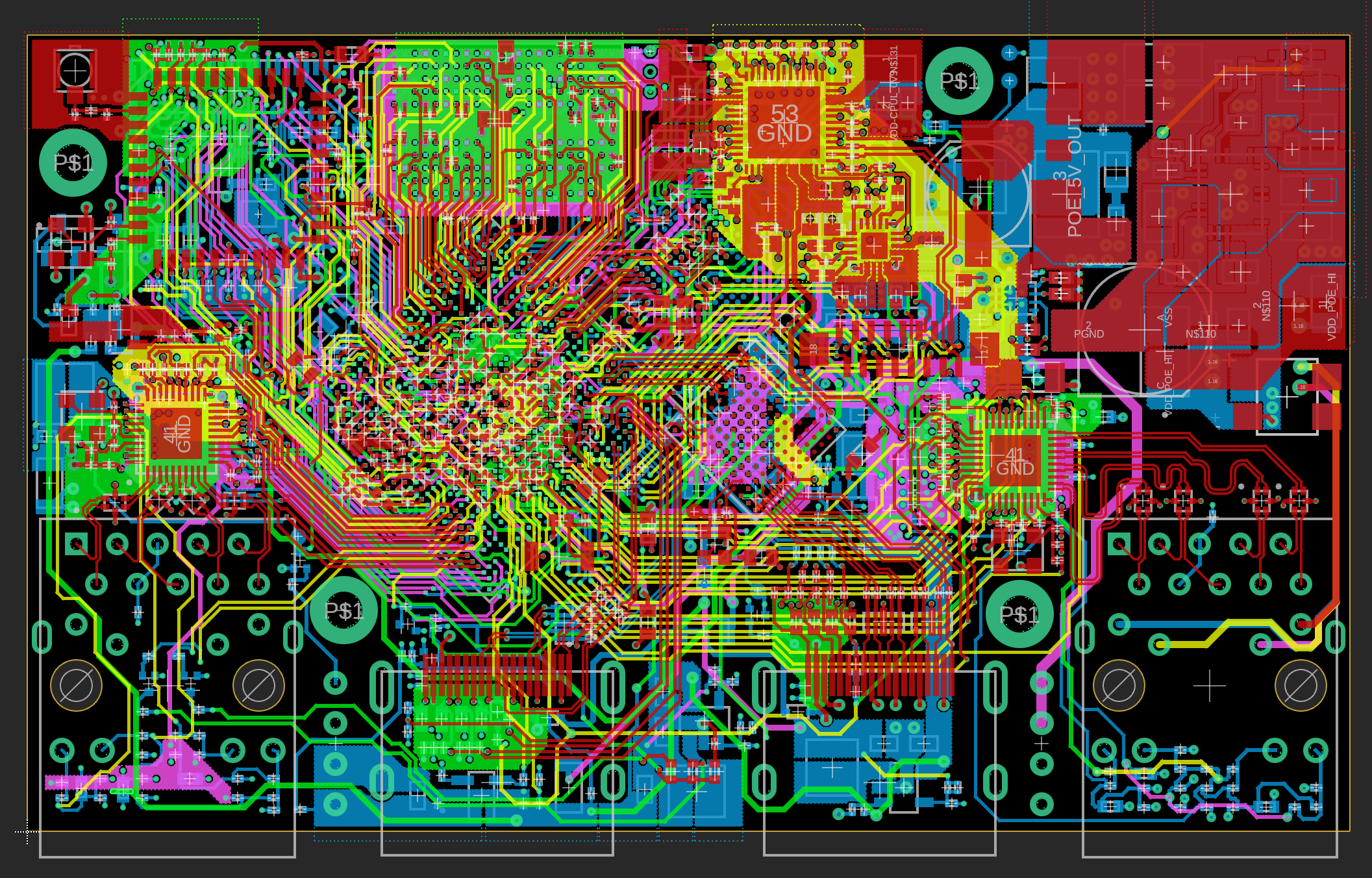
It was never ordered, because the video path never worked. The whole product depends on the RK628D, the chip that turns incoming HDMI into something the SoC's camera interface can read. On the Cubie, I could not get it running. The firmware support just was not there, and it was not even clear the A527's camera lanes could take 4K. That is five months of evenings and weekends on a chip that could not do the one thing the product needs.
October 2025: Rockchip
When I finally sat down and compared options, there were three:
- Allwinner A733. About $15. I suspected its Linux support would be the same story again.
- Rockchip RK3582. A binned RK3588S. I could not source it, and when I could get a price it was higher than the next option.
- Rockchip RK3576. About $20, with 4K60 H.264 and H.265 encode, and, most important, the RK628 is Rockchip's own part with native support.
I picked the RK3576 on October 26, 2025, and told the team, half joking, "I promise we'll stick with this SoC this time." That was the right call for the flagship, and it still is.
A Firefly RK3576 dev board arrived on November 4.
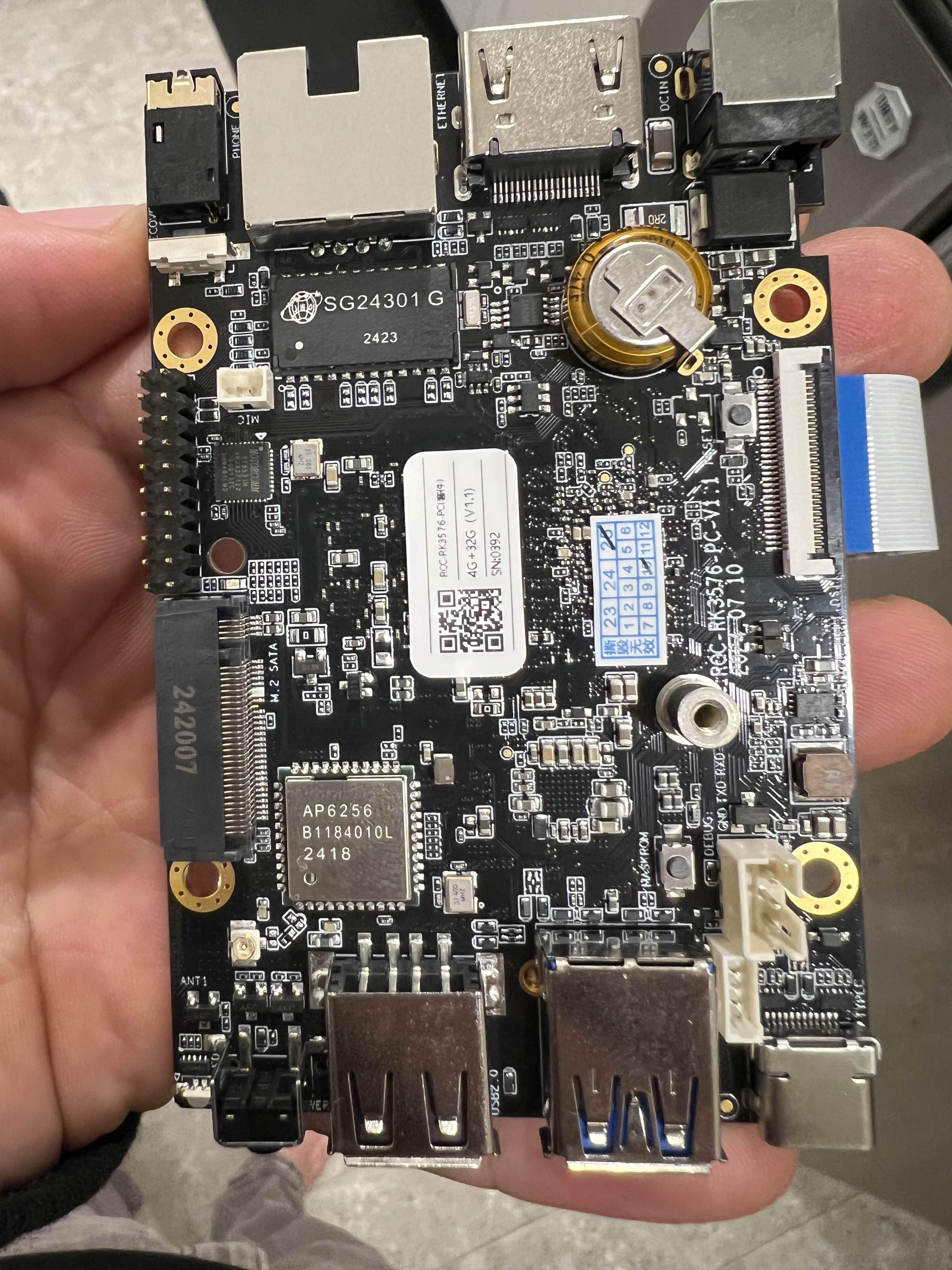
The RK628D captured video that same night. Four days later my laptop desktop was streaming through it, with plenty of artifacts, but through it.
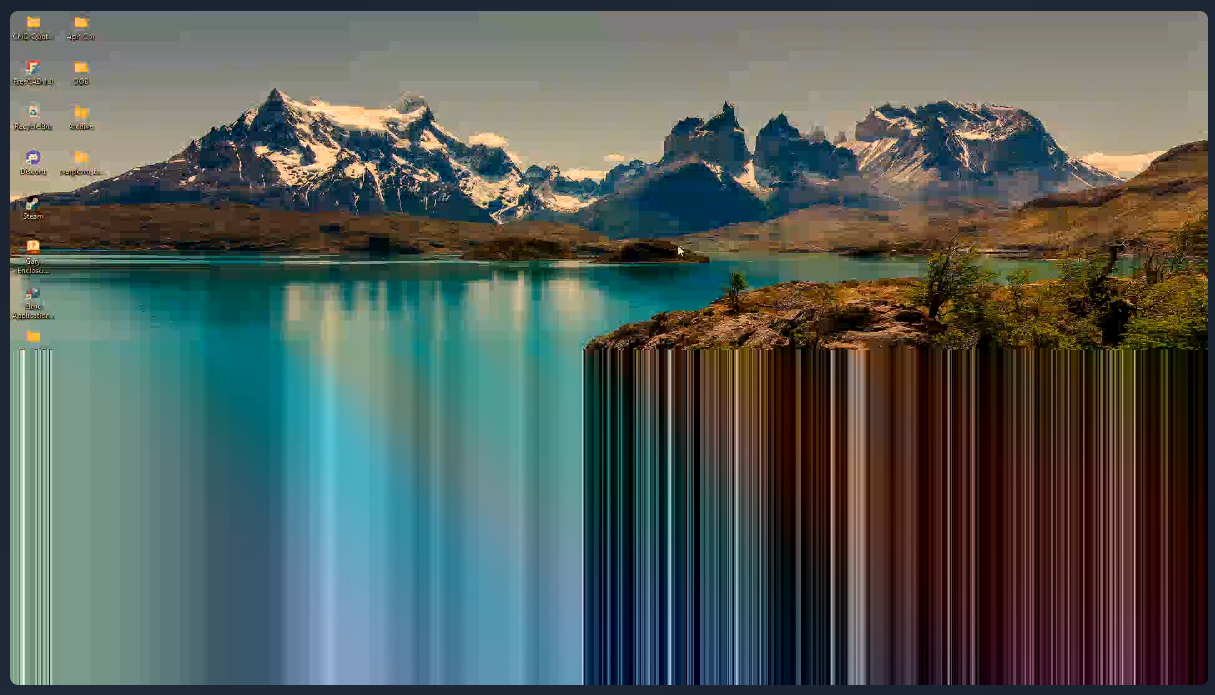
Five months on one platform with no video, four days on the other with video. If I could only keep one lesson from this whole project, it would be that one: buy the dev board and prove the signal path first.
The 1080p model: one MAC, then two, then one
The flagship was settled, but we also wanted a cheaper 1080p model, and the RK3576 is not a cheap chip. It also does not support DDR3, only LPDDR4, LPDDR4X, LPDDR5 and LPDDR5X, so there was no cheaper memory to pair it with.
In January 2026 I floated the RK3566 with DDR3, and turned it down within a day because it has one Ethernet MAC. I wanted two ports, one in and one out, so units could chain together and pass network through to the machine they control. The RK3568 has two MACs, and it can do 1080p encode, so on January 18 it became the 1080p chip. It has only one camera interface, which was fine for 1080p.
Then in May 2026 we added a network switch chip, the Realtek RTL8363NB, to keep latency down on the pass-through port. We also looked at the Microchip KSZ9893, which had better reference designs and firmware support, but the RTL8363 was roughly $2 against roughly $8.50 on the distributor listings, and it had stock. The switch has its own PHYs, so the discrete Ethernet PHY chips came off the board too.
With a switch doing the networking, the SoC only needs one MAC. The second MAC on the RK3568 was now paying for nothing, so the 1080p board went back to the RK3566, which is cheaper. The trade-off is real: both Ethernet ports now share a single gigabit link into the SoC. For a KVM stream plus passthrough, that is enough.
So the RK3566 I rejected in January for having one Ethernet MAC became the right chip in May, for exactly that reason. For an owner, the shared link rarely matters, because a compressed KVM stream is a small slice of a gigabit. It shows up only if you push a large file transfer through the passthrough port while you are also using the KVM, because both now share the same uplink.
September 2026: the RV1126B
The RK3566 board came up on its first spin in September, with a few fixes along the way, which I count as a success. Those fixes are their own post. By then we had already found a better chip for it.
The RV1126B is a Rockchip vision SoC with 4K H.264 and H.265 encode and camera interfaces that can run as two 4-lane links. For us it beat the RK3566 on every line that mattered:
- More resolution for less money. It captures and streams 4K30 on the DIY board (a Luckfox Aura with our RK628H capture board), where the RK3566 encoder tops out at 1080p60. And it costs about $9.63 on the distributor listing, against about $14 for the RK3566. That is what the WarpKVM 02 does now. Its latency numbers get published after the retest on the current rig, not before.
- Off-the-shelf boards run it. The Luckfox Aura is an RV1126B board you can buy today. So the DIY WarpKVM is a Luckfox Aura plus our capture board, and our own WarpKVM 02 board runs the identical firmware. One firmware, two products.
We picked the full RV1126B over the cheaper RV1126B-P (about $7.95) because we need the wider camera interface. The RTL8363 switch stays, so the WarpKVM 02 keeps both Ethernet ports.
Remember the chip I avoided in 2025 because I thought a competitor could not do 4K on theirs? The WarpKVM 02 ended up in the same RV1126 family GL.iNet uses. I did not know the RV1126B existed when I made the Allwinner call. If you are choosing a chip for a capture device, look past the parts your category already uses, including vision SoCs built for cameras. That is where the best fit was hiding.
What I would tell someone picking an SoC for video
- Start from the video path. Capture bridge, camera interface lanes, and encoder, in that order. Everything else on the spec sheet is secondary for a product like this.
- Check the software support before the price. The A527 was the cheapest chip in this story and cost the most time. A native driver for your capture chip is worth more than a few dollars of BOM.
- Buy the dev board first. Four days on a Firefly board told me more than five months of Allwinner schematics.
- Count Ethernet MACs against what a switch costs. A $2 switch chip turned a two-MAC requirement into a one-MAC one, and changed which SoC was cheapest.
- Your memory type is part of the SoC choice. The RK3576 cannot use DDR3, so picking it also picked LPDDR4X, right before DRAM contract prices rose 90 to 95% in a single quarter. That spike is what took an enclosed sub-$100 model off the table.
Next up is the chip that decided all of this: the RK628 capture bridge, from the D to the H.