July 28, 2026
Who Makes IP KVM Devices? Owners, Jurisdictions, and Where Your Data Goes
A KVM sees your screen and types your keystrokes. For a box like that, who runs the company and where it sends your data matters more than where it was built.
By Andrew Douglass · Founder
Disclosure: Our articles contain affiliate links, including Amazon. If you buy through one, we may earn a commission at no extra cost to you, and as an Amazon Associate we earn from qualifying purchases. It never affects our testing, measurements, or verdicts. Full disclosure.
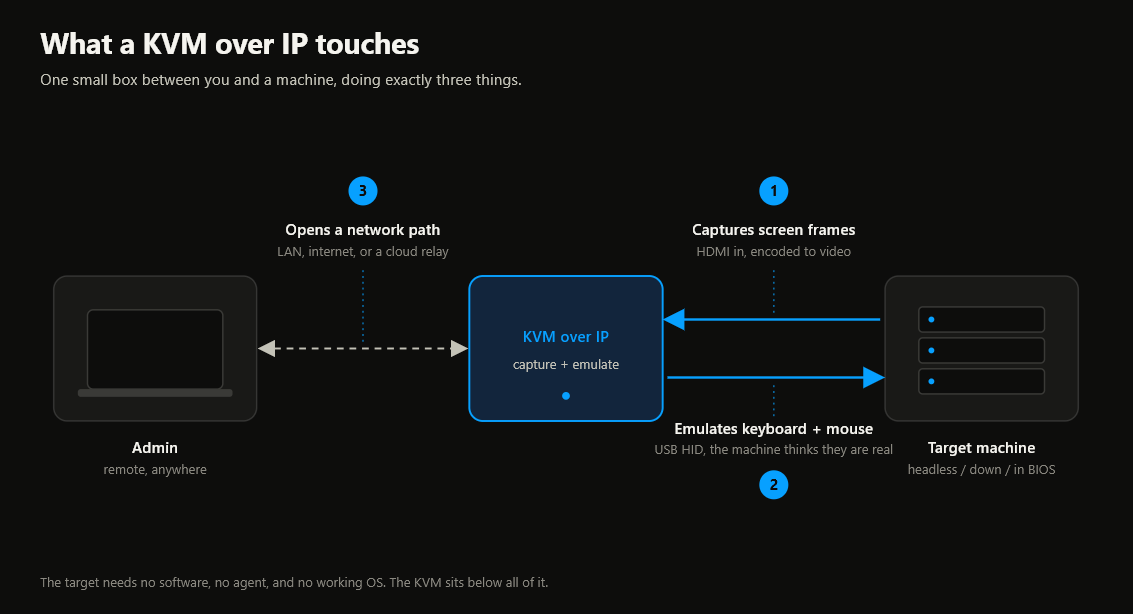
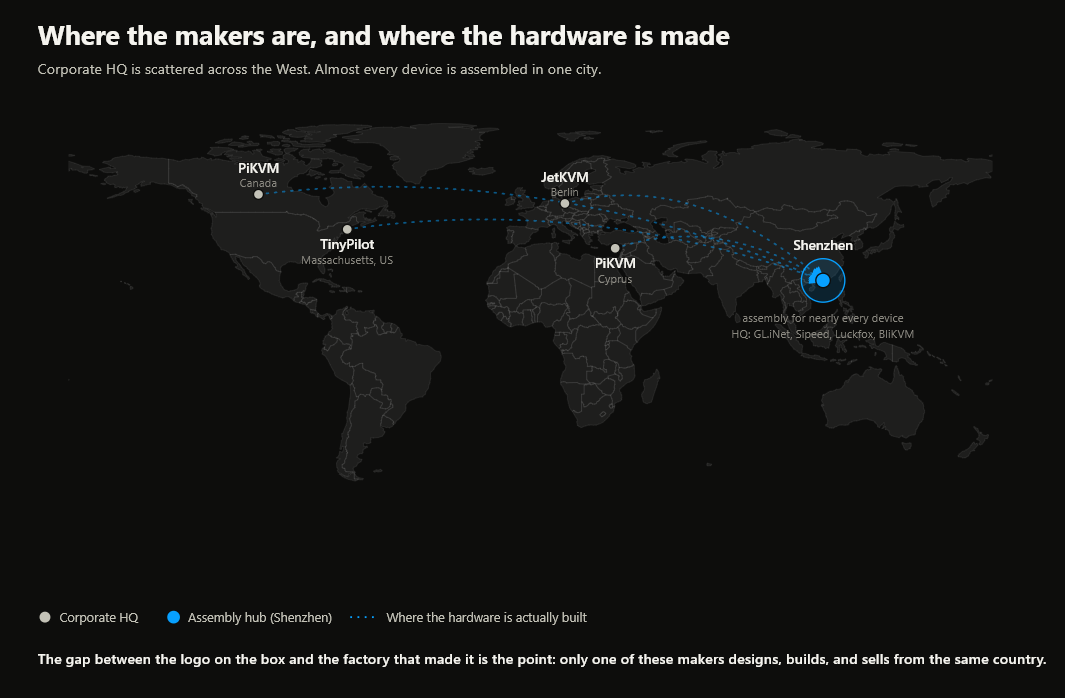
A KVM over IP is a small appliance for controlling a computer remotely at the hardware level: it captures the machine's video, emulates its keyboard and mouse, and exposes both over the network, so you can reach a headless or crashed server from anywhere. So who makes IP KVM devices? A short list of small companies spread across Germany, the United States, China, and Cyprus, and nearly all of them build the hardware in Shenzhen.
For a device that sits between you and a server, there is often a second question after who makes it: where the company is based, what rules it answers to, and where the device sends data. This guide maps the makers behind the popular KVM-over-IP devices on those terms, sticking to what is publicly documented and flagging what is not.
Manufacturing, ownership, and data are three separate questions
Almost every small IP KVM on the market is manufactured in China, including devices sold by companies headquartered in Germany and the United States. Contract assembly in Shenzhen is the default for this class of hardware, as it is for most consumer electronics, so the country stamped on the box is only one data point.
Two others often get folded into the same conversation but are distinct:
- Who legally owns and runs the company. That determines who provides support, who is accountable if something goes wrong, and which country's consumer and privacy law applies.
- Where the device sends data. Whether it connects to a vendor's servers at all, in which country those servers sit, and whether you can disable that and self-host instead.
How much weight each carries depends on how sensitive the machines behind the KVM are. The sections below lay out where each maker stands on all three.
What an IP KVM can actually see
A KVM over IP is not a passive cable. It captures the target machine's video output frame by frame, emulates a USB keyboard and mouse so it can type and click, and exposes all of that over the network so you can reach a headless or crashed box from anywhere. Many models add virtual media, ATX power control, and a cloud relay for access without a VPN. It captures the target's HDMI output, and you reach it through a web browser, with some models also exposing VNC or a serial console. That is different from remote-desktop software like RDP, VNC, or TeamViewer, which runs inside a working operating system. A KVM works below the OS, so it still functions when the machine is sitting at the BIOS screen or has crashed outright.
That capability is the whole point, and it is also why provenance matters here more than it does for a webcam. Anything that can see your screen and inject keystrokes is worth understanding before it goes on your network. Enterprise servers solve the same problem with a baseboard management controller (Dell iDRAC, HPE iLO, or generic IPMI), which is a chip on the motherboard from a known vendor. The standalone IP KVM market is where the ownership picture gets more scattered.
The makers, one by one
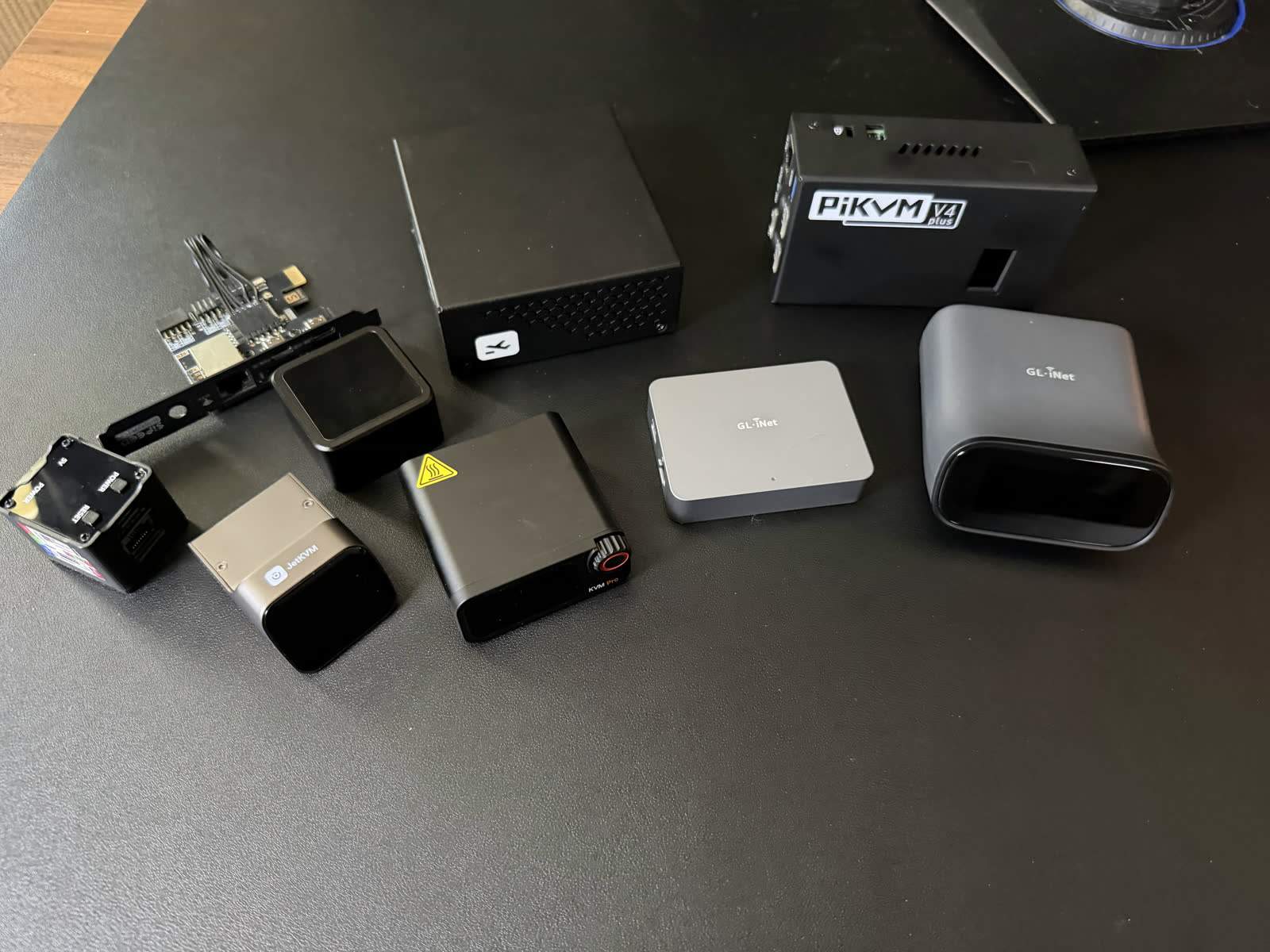
JetKVM is designed by a two-person team in Berlin, Germany: Adam Shiervani and Lian Duan. The device was crowdfunded on Kickstarter, closing in December 2024 at over four million dollars, and the hardware is manufactured in China. One common misconception is worth correcting: JetKVM is sometimes called "a Y Combinator company." The founders' Y Combinator company is actually BuildJet (W23), a separate CI cloud venture. JetKVM is their own crowdfunded project. JetKVM does not prominently disclose which legal entity sells and operates the device, which is a fair thing to note for a product this network-connected. It offers an optional cloud for remote access, and you can skip it and self-host over Tailscale or a VPN instead.
TinyPilot is the clearest United States story, with an asterisk. It is registered as TINYPILOT LLC in Massachusetts and was founded and bootstrapped by Michael Lynch, an American engineer formerly at Microsoft and Google, who documented the whole business publicly. The asterisk: Lynch sold TinyPilot in April 2024 for around 600,000 dollars to a private individual, and the roughly seven-person team stayed on. Assembly had already moved from in-house US hand-building to a contract manufacturer in Vietnam in late 2023. So TinyPilot is a US-registered company under new private ownership, with hardware assembled in Vietnam. Lynch is the founder, not the current owner. Our TinyPilot Voyager review covers the product itself.
PiKVM is the open-source veteran. The project and its lead maintainer, Maxim Devaev, sell the V4 hardware through an entity whose site footer reads PiKVM LTD, Canada and Cyprus. Devaev is Russian by background (his own writing references years at Yandex and a Russian education) and his public profile now lists Cyprus. This is a jurisdiction fact, not a verdict: PiKVM's software is fully open source and self-hosted, so there is no vendor cloud in the path unless you add one. That transparency is the reason it remains a homelab default. Several other makers, including BliKVM, build on PiKVM's GPL software.
GL.iNet makes the Comet line (GL-RM1, Comet Pro, Comet X). It is an established networking-hardware company: its own About page lists a Shenzhen, China headquarters for management and R&D, a Hong Kong office for design and marketing, and an in-house Shenzhen factory. Founders Mason and Alfie Zhao have run it since 2010, and a US support entity, GL Intelligence Inc, was added in Virginia in 2024. Of the Chinese makers, it is the most conventional, established corporation. See our GL.iNet Comet coverage for the hardware.
Sipeed makes the NanoKVM. The legal entity is Shenzhen Sipeed Technology Co., Ltd., confirmed through its FCC filings, a RISC-V and open-hardware maker based in Shenzhen. The NanoKVM is the cheapest way into this category and also the one with the most-scrutinized data behavior, covered below.
Luckfox (Shenzhen Luckfox Technology Co., Ltd., trademark-confirmed, founded 2020) makes the low-cost Luckfox Pico KVM. BliKVM is Blicube, a China-based maker whose devices run PiKVM-derived open-source software; it is an independent third party to the PiKVM project, not an official partner. Both are Shenzhen operations.
IP KVMs come in a few shapes: single-port boxes for one machine, multi-port and matrix appliances that switch a whole rack, and KVM-over-IP extenders for point-to-point video at a distance. Every small device in this guide is single-port and effectively single-user. The enterprise incumbents cover the multi-port, matrix, and extender roles, adding multi-user access with per-user permissions, and they sit in a different tier of provenance: ATEN is a large public company based in Taiwan, Raritan and Vertiv (which owns Avocent) are US-based corporations, and Matrox builds extenders in Canada. Their appliances are on-premises, BMC-style products with none of the small-vendor cloud questions, and they turn up in datacenters and in government, healthcare, education, and broadcast facilities where out-of-band access is mandatory, at several times the price.
Who answers to whom, at a glance
| Maker (product) | HQ / jurisdiction | Who owns / runs it | Where your data can go |
|---|---|---|---|
| JetKVM | Berlin, Germany; hardware made in China | Adam Shiervani & Lian Duan (also founded BuildJet, YC W23); operating entity not clearly disclosed | Optional JetKVM cloud relay, or self-host via Tailscale/VPN |
| TinyPilot Voyager | US (TINYPILOT LLC, Massachusetts); assembled in Vietnam | Private owner since founder Michael Lynch sold it in April 2024 | Self-hosted web UI; no mandatory cloud |
| PiKVM V4 | PiKVM LTD (Canada / Cyprus); founder Russian-origin, now lists Cyprus | Maxim Devaev and the open-source project | Fully self-hosted; no vendor cloud in the path |
| GL.iNet Comet | Shenzhen, China (R&D) + Hong Kong; US support entity in Virginia | Mason & Alfie Zhao (GL.iNet, since 2010) | GL.iNet cloud optional; self-hosting supported |
| Sipeed NanoKVM | Shenzhen, China | Shenzhen Sipeed Technology Co., Ltd. | Defaulted to Chinese DNS and Sipeed servers; a security report flagged this, since partly addressed |
| Luckfox PicoKVM | Shenzhen, China | Shenzhen Luckfox Technology | Local web UI; forked JetKVM firmware, self-hostable, no vendor cloud |
| BliKVM | Shenzhen, China | Blicube (BliKVM) | Self-hosted; runs PiKVM-derived (kvmd) software, no vendor cloud |
| ATEN / Raritan / Vertiv | ATEN: Taiwan. Raritan, Vertiv: US | Large public corporations | On-premises enterprise appliances; no small-vendor cloud |
Where your data actually goes
The clearest case study here is data destination, and the Sipeed NanoKVM is the example. A security researcher published an analysis that found a tiny surface-mount microphone on the board (activatable over SSH), no CSRF protection, a hardcoded encryption key identical across all units, reliance on Chinese DNS, and communication with Sipeed servers in China. The reporting was corroborated by Cybernews and others.
Two things keep this fair. Sipeed disputed that the microphone was "undocumented," saying it was listed on the LicheeRV Nano wiki that the NanoKVM is based on, and it later added a direct reference on the NanoKVM page. And per Tom's Hardware, many of the security issues have since been addressed. The device is not malware, and you can run it air-gapped or on an isolated VLAN. Our NanoKVM review covers how to do that.
The case is a useful illustration because of its range: not just a microphone, but default DNS, server locations, an encryption key, and update channels, all outside the operator's control by default. Those factors apply to any KVM that connects to a vendor's infrastructure, wherever the company is based, and a device you fully self-host does not raise them.
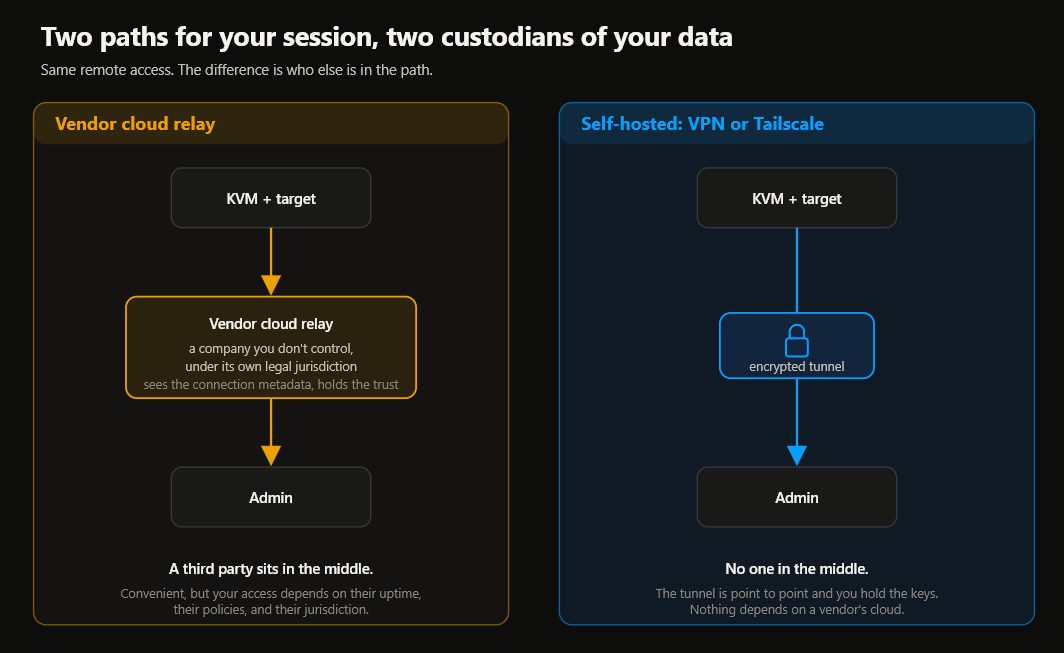
So the practical hierarchy is: a device you fully self-host (PiKVM, TinyPilot, or any of them behind your own VPN) keeps the data path under your control regardless of where the company sits. A device that relies on a vendor cloud puts that vendor, and its jurisdiction, in the middle. If you go the self-hosted route, our guide to locking down remote KVM access walks through the network segmentation and tunneling.
The factors buyers weigh
You do not need to trace a corporate registry. When choosing the right KVM over IP, buyers commonly weigh a handful of security considerations, and five questions cover most of them:
- Can you self-host it with no vendor cloud? If yes, the company's jurisdiction matters far less, because nothing has to leave your network.
- If it phones home, to where, and can you disable it? Check the default DNS and outbound connections, not just the marketing.
- Is the firmware open or at least inspectable? Open source (PiKVM, JetKVM's firmware, BliKVM) means the data behavior is auditable rather than assumed.
- Is there a named, reachable legal entity behind it? Someone you can hold accountable under a legal system you understand.
- What jurisdiction is that entity in? Not as a proxy for trust, but so you know which rules apply to your data and your recourse.
Run those five against any device on the best KVM-over-IP shortlist and the picture usually clears up. Price and headquarters country are weak predictors on their own; ownership, firmware openness, and the data path are more informative.
FAQ
FAQ
JetKVM is designed by a two-person team in Berlin, Germany (Adam Shiervani and Lian Duan) and the hardware is manufactured in China. The founders' Y Combinator company is a separate venture called BuildJet, not JetKVM, which was crowdfunded on Kickstarter.
Founder Michael Lynch sold TinyPilot in April 2024 for around 600,000 dollars to a private individual, and the small team stayed on. It remains a US-registered company (TINYPILOT LLC, Massachusetts), though assembly moved to a contract manufacturer in Vietnam in late 2023. Lynch is the founder, not the current owner.
A security researcher's report found an on-board microphone, a hardcoded encryption key, and communication with servers in China. Sipeed disputes that the microphone was undocumented and has addressed many of the flaws since. It is usable, particularly air-gapped or on an isolated VLAN. See our NanoKVM review and security guide.
Less than most people assume. Nearly every small IP KVM, including US-branded ones, is manufactured in China. What matters more is who owns the company, what jurisdiction it answers to, and whether the device sends your data to a vendor cloud you cannot disable.
PiKVM and TinyPilot are self-hosted by design, and any device can be kept off a vendor cloud by reaching it through your own VPN or Tailscale instead of the manufacturer's relay. Self-hosting is the most reliable way to keep the data path under your control.
Disclosure: WarpKVM, which publishes this guide, makes an IP KVM device and is one of the makers in this market. The facts above are drawn from public records and reporting, and we have tried to represent every company fairly.