November 17, 2026Comparison
JetKVM vs GL.iNet Comet (and Comet Pro): Which Should You Buy?
The two best budget IP KVMs, tested side by side. Winners named per scenario, from bare price to PoE racks to 4K desktops.
By Andrew Douglass · Founder
Disclosure: Our articles contain affiliate links, including Amazon. If you buy through one, we may earn a commission at no extra cost to you, and as an Amazon Associate we earn from qualifying purchases. It never affects our testing, measurements, or verdicts. Full disclosure.
JetKVM vs GL.iNet Comet is the closest call in budget KVM over IP, and we run both daily. The short answer: JetKVM ($69) wins on price, openness, and design; the Comet ($79 to $99.99) wins on capture resolution, PoE, and accessories; the Comet Pro ($179.99) wins outright on features if the budget stretches. The right pick follows from which of those sentences describes your rack.
Hardware specifications and design
| JetKVM | GL.iNet Comet | GL.iNet Comet Pro | |
|---|---|---|---|
| Price | $69 | $79-$99.99 (PoE $115.99) | $179.99 |
| Max capture | 1080p@60 | 4K@30 | 4K@30 + 4K passthrough |
| Latency (LAN) | 30-60 ms | 30-60 ms | 30-60 ms |
| Display | 1.69-inch touchscreen | Status LED | 2.22-inch touchscreen |
| Network | Gigabit Ethernet | Gigabit Ethernet (PoE variant) | GbE + Wi-Fi 6 |
| Storage | microSD (TF) | 8GB eMMC | 32GB eMMC |
| Open source | Fully (firmware + web) | Partly | Partly |
| Power control | RJ11 extension (ATX/DC) | ATX board, fingerbot | ATX board, fingerbot |
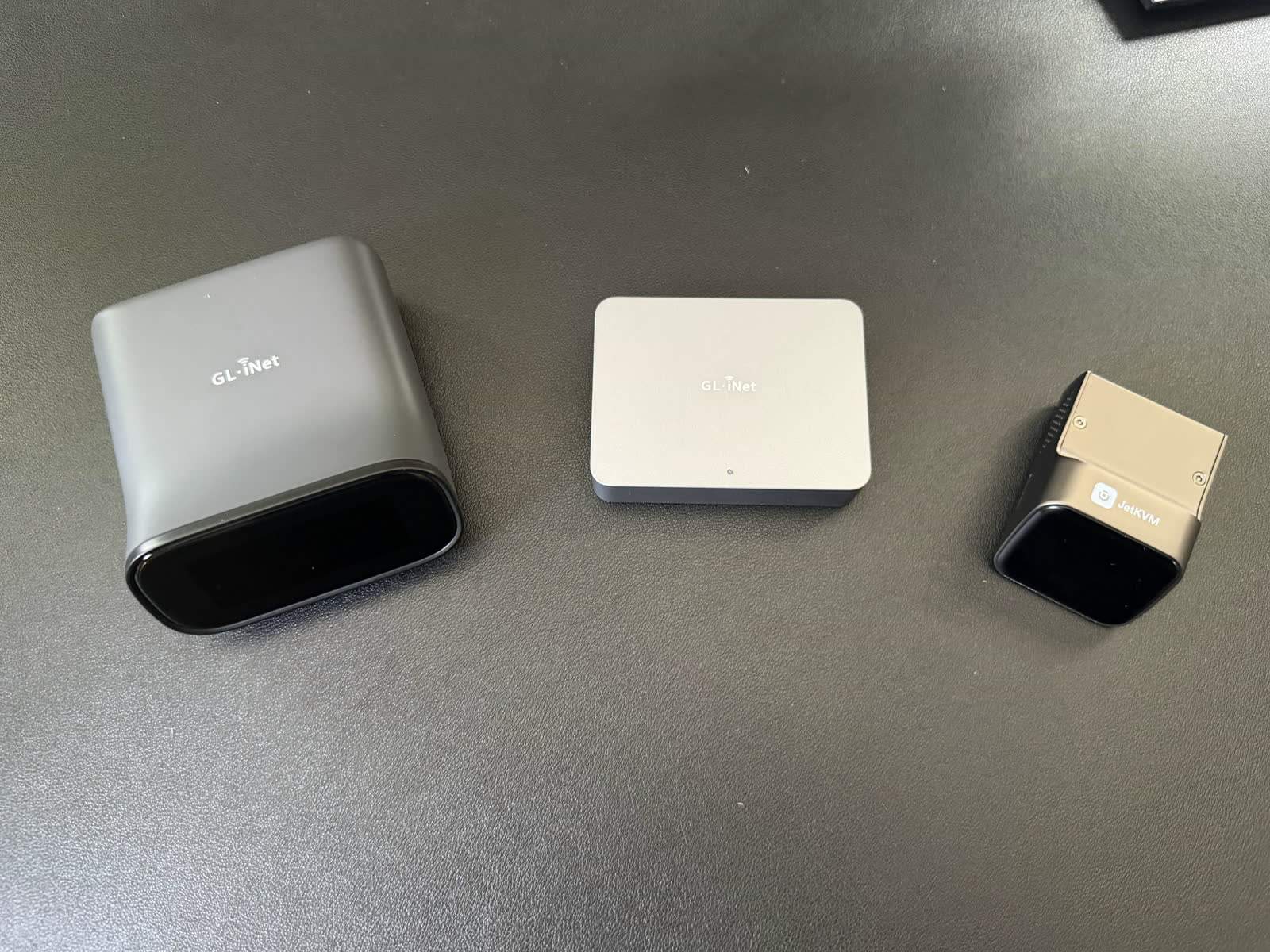
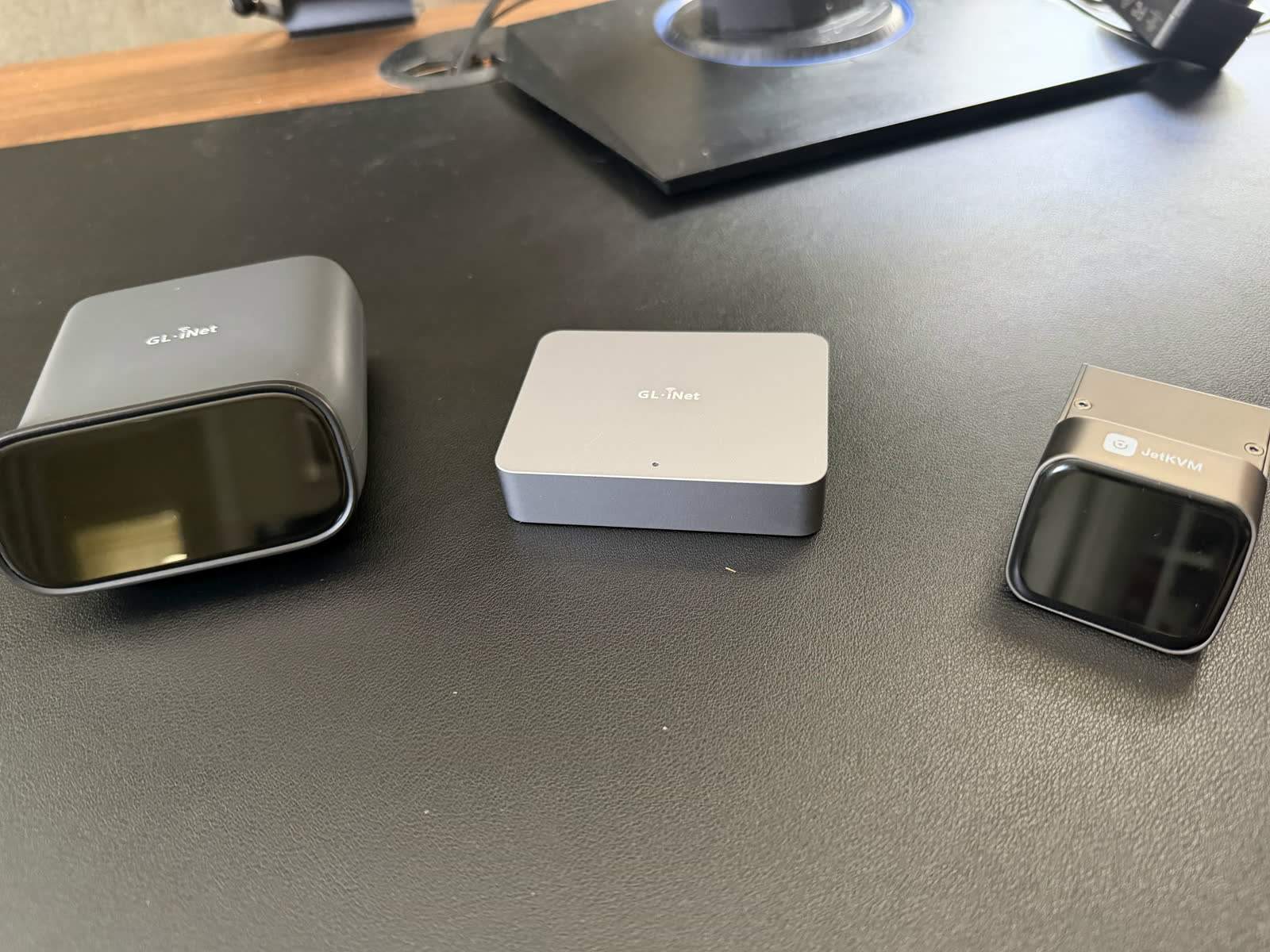
Design is JetKVM's clearest win: the machined-feeling mini enclosure with its crisp little touchscreen remains the nicest object in the category. The Comets are competent black plastic, denser than they look, with the Pro's larger touchscreen doing real work (IP address, status, quick actions); ServeTheHome's hardware overview has board-level shots. Build quality on all three has survived a year of our recabling abuse without complaint.
Ports and connectivity
JetKVM: HDMI in, USB-C to host, gigabit Ethernet, and the clever RJ11 extension port that carries ATX/DC power-control signals. Comet: HDMI in, USB-C data and power, gigabit Ethernet, with the PoE model folding power into the network cable. Comet Pro: adds HDMI passthrough out, a USB-A port, and Wi-Fi 6 antennas. If the machine you need to reach has no nearby Ethernet drop, the Pro is the only option here that works over wireless.
Performance and video quality
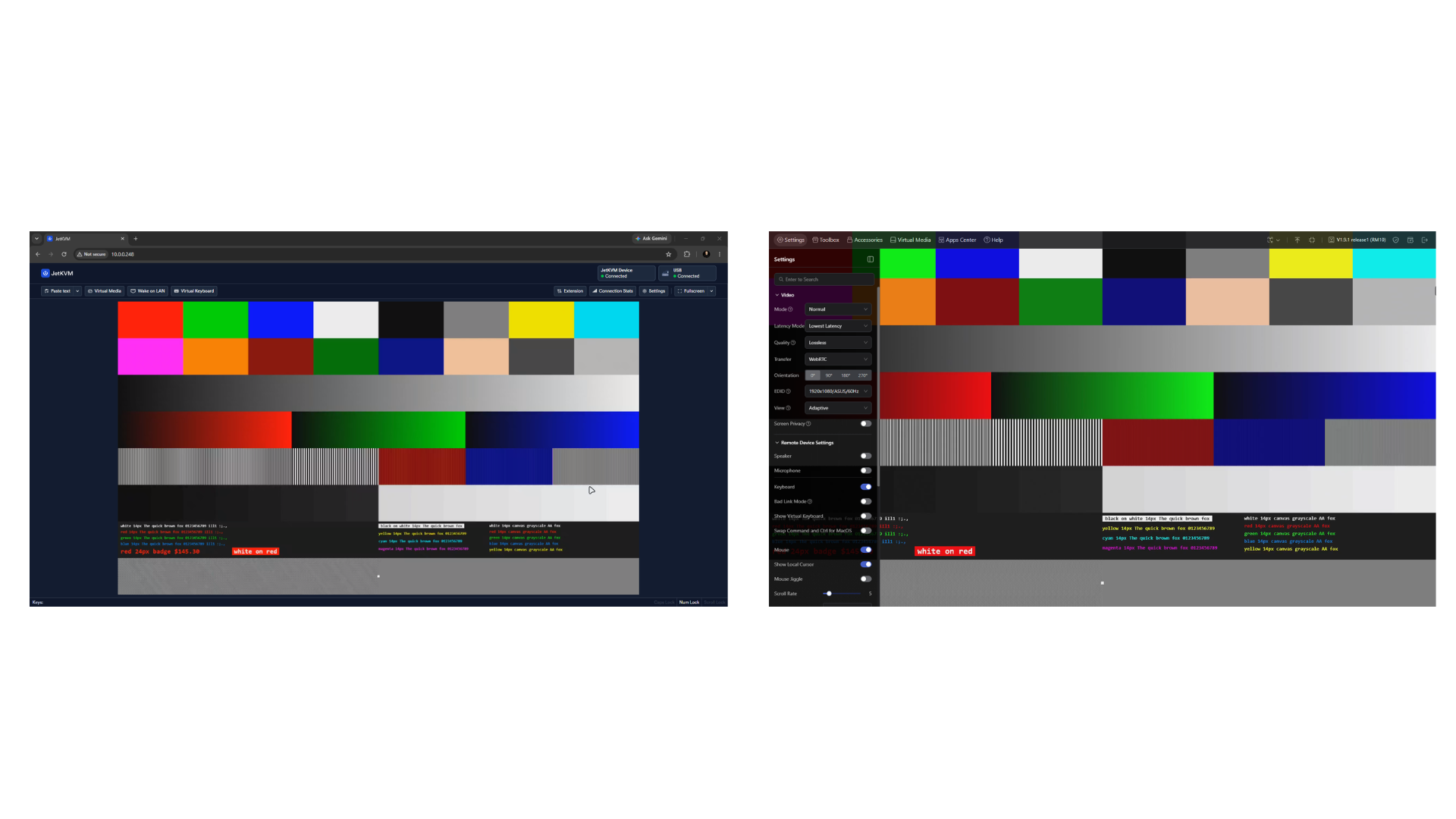
On a gigabit LAN, all three hold the 30 to 60 ms band that makes remote typing feel local, and in blind A/B typing tests we could not reliably tell them apart. NAS Compares' Comet Pro vs JetKVM testing reached the same effectively-tied conclusion on feel. Both stream 1080p60 as the daily mode. The Comets add 4K@30 capture, which matters exactly when your target runs a 4K desktop and you need to read small text: 30fps motion is steppier, but the pixels are real. JetKVM deliberately stays at 1080p to protect its latency envelope, a defensible engineering choice. (Nobody here does 4K@60; that story is here.) For where the milliseconds go, see our latency explainer.
HDMI passthrough
Comet Pro only: the target's video continues to a local monitor while the Pro captures. On a workstation someone also uses in person, this feature alone decides the purchase; neither the JetKVM nor the base Comet offers it, and among the wider field only the PiKVM V4 Plus does.
Power options: PoE, USB-C, and power delivery
JetKVM is USB-C powered, full stop (PoE has been a long-running community request). The Comet line answers it twice: the GL-RM1PE takes PoE natively at $115.99, and every variant runs on USB-C. For rack deployments where one cable per device is the goal, the Comet PoE or a TinyPilot Voyager 3 Plus are the clean answers.
Storage and virtual media (ISO mounting)
All three mount ISOs as emulated USB drives and boot targets from them; we have reinstalled operating systems through each. The Pro's 32GB eMMC comfortably holds an installer library, the base Comet's 8GB holds two or three images, and JetKVM leans on its microSD slot. Functionally a wash for occasional use; the Pro pulls ahead for teams that reimage often.
Touchscreen and display features
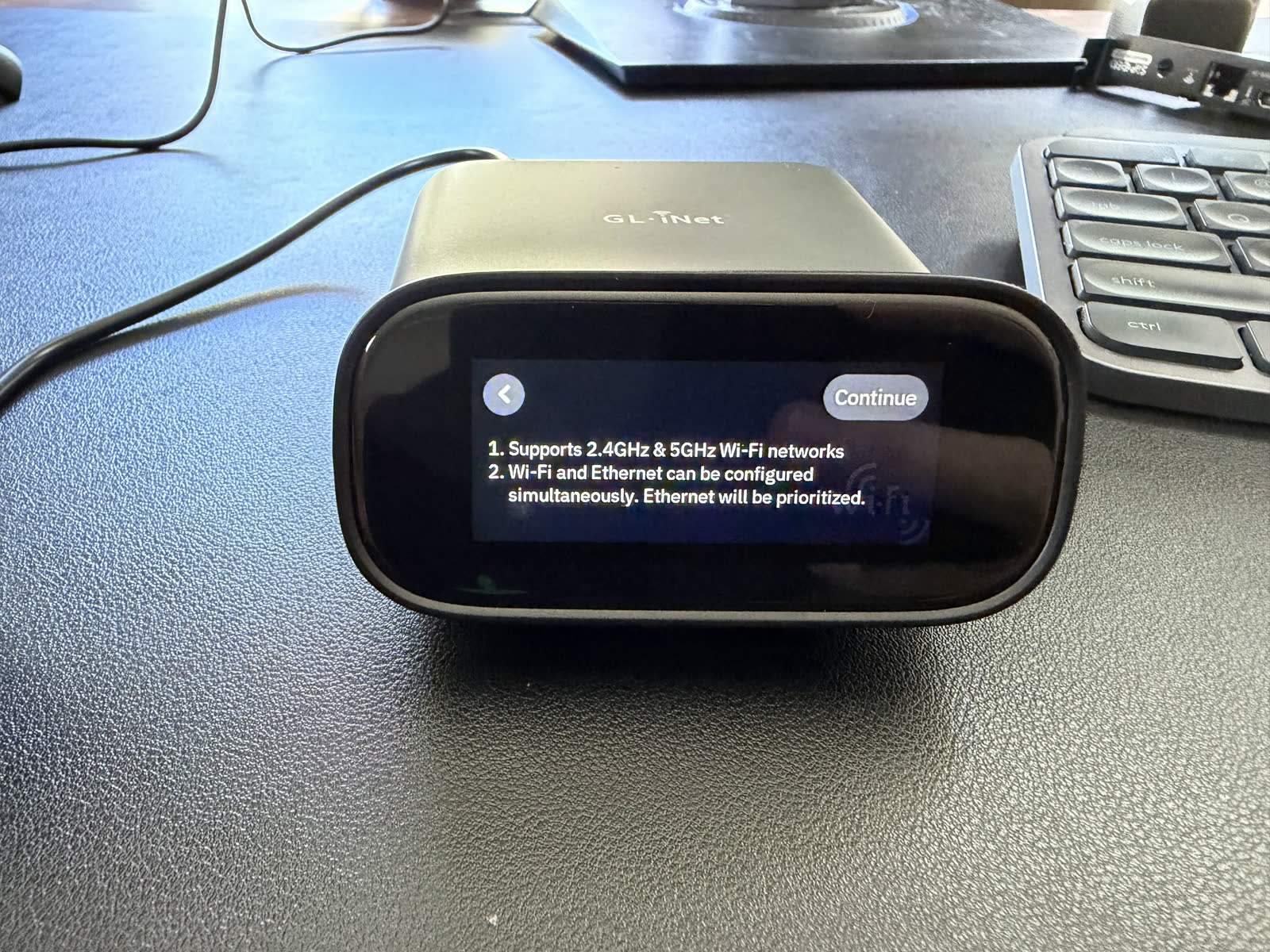
JetKVM's 1.69-inch touchscreen shows status and IP; the Comet Pro's 2.22-inch screen adds quick actions; the base Comet makes do with an LED and its app. Practical value: finding a device's IP without opening a router page is worth more than it sounds, and both touchscreen devices deliver it.
Wi-Fi and wireless connectivity
Comet Pro exclusive: Wi-Fi 6 (plus a 5G variant, the GL-RM10RC, for cellular failover scenarios). JetKVM and base Comet are wired-only. Wireless KVM access sounds wrong until the day the machine you must reach sits where no cable does.
ATX power control and accessories
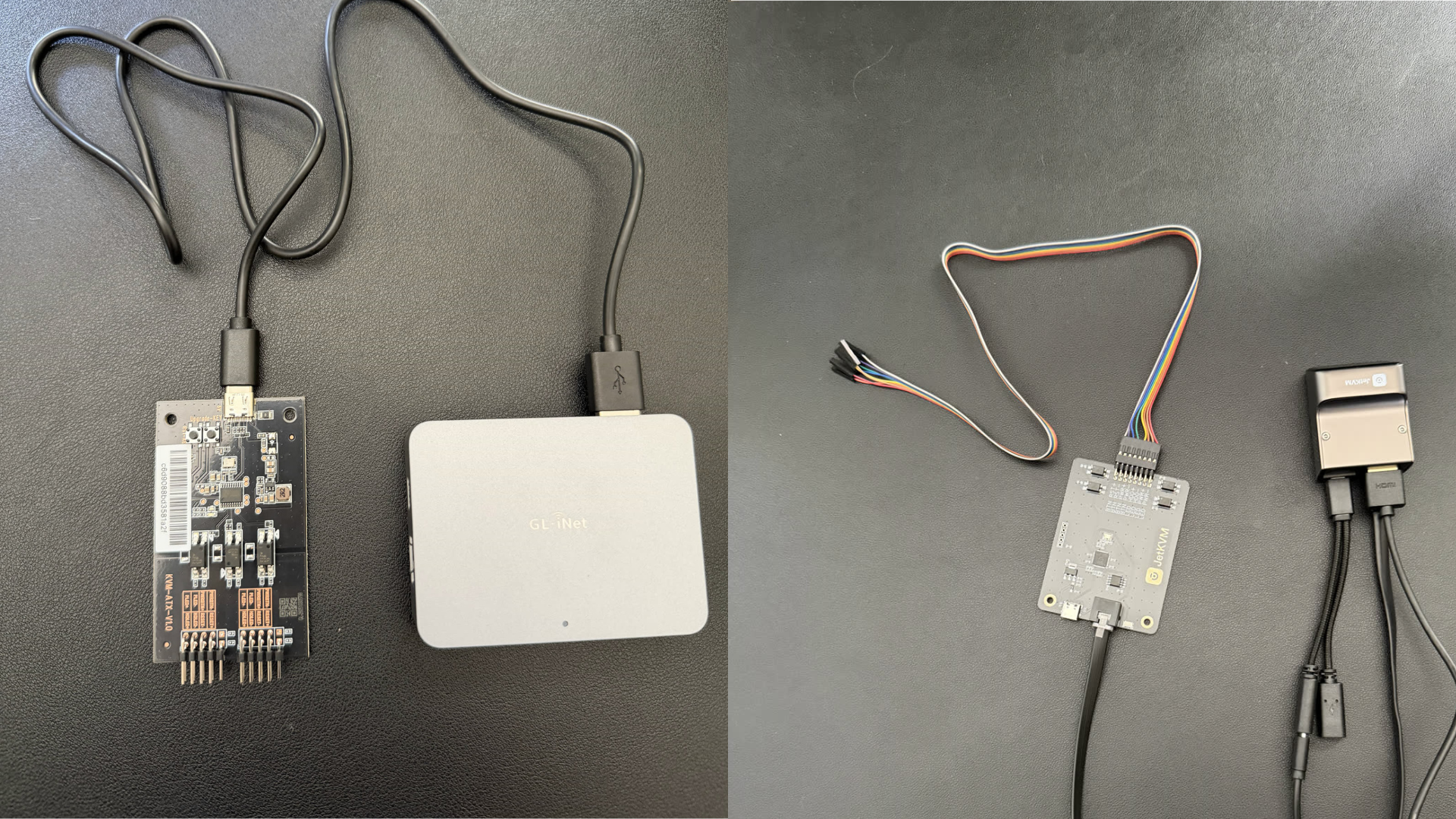
JetKVM's RJ11 extension port carries its ATX and DC power-control add-ons, tidy and first-party. GL.iNet counters with the GL-ATXPC header board plus the fingerbot, a motorized button-pusher for sealed machines that has no equivalent anywhere in the category. Coverage for "the machine is hard-hung and I am far away" is strong on both sides; GL.iNet covers more physical situations.
Open source and software stack
JetKVM's firmware and web application are fully open source, with an active community shipping integrations; that is the whole ideology of the device and the reason many buyers pick it. GL.iNet open-sources parts and keeps parts closed; you get faster feature cadence and a slicker app ecosystem, and you cannot fully audit the box. After 2026's security audits of budget IP KVMs, that difference moved from philosophical to practical for some threat models.
Firmware and software updates
Both vendors iterate fast and both push updates through clean in-UI flows. GL.iNet's cadence is the fastest in the category and its GLKVM desktop/mobile apps keep gaining features; JetKVM's updates arrive alongside a public repository where you can read exactly what changed. No stagnation risk on either side, which is not something every competitor can claim.
Remote access and cloud features: Tailscale and WebRTC
Tied, deliberately: both integrate Tailscale natively (the correct answer), both offer optional vendor relays for people who refuse overlays, and both stream over low-latency WebRTC-class transport. Deployment rule regardless of pick: isolated management VLAN, no port forwarding, overlay network only.
Security and network behavior
Independent packet-capture testing across the budget KVM field has generally treated both vendors as the responsible end of the market, in contrast to the launch-era NanoKVM findings. JetKVM's full openness makes verification trivial; GL.iNet's partial openness asks for some trust but has not abused it. Either way, treat any IP KVM as the hardware backdoor it is and deploy per the hardening guide.
Setup and installation
Ten minutes each, genuinely. JetKVM edges the first-run experience with its touchscreen showing the IP immediately; the Comet's app-assisted discovery is nearly as painless, and the Pro's screen matches JetKVM's trick. All three needed zero driver or EDID fiddling on our Intel, AMD, and Raspberry Pi targets.
Build quality and thermals
All three run cool and silent (passive, no fans) under continuous 1080p60 encode. The Comets warm noticeably in 4K@30 mode without ever throttling in our use. JetKVM's metal-and-glass build feels the most premium; the Comets' plastic is unglamorous and fine.
Pricing and value
JetKVM $69. Comet $79 to $99.99, PoE $115.99, Pro $179.99, accessories cheap. The $10 to $30 gap between JetKVM and base Comet buys 4K@30 and the accessory ecosystem, which is why the base Comet is our default recommendation for buyers who are not ideological about open firmware. The Pro's $110 premium over base is the honest decision point: passthrough + Wi-Fi + screen + storage either solves your problem or it does not.
Comparison with competitors
Both beat the NanoKVM on software polish and trust history, while the NanoKVM Pro beats both on raw capture resolution (4K@45). PiKVM remains the depth pick (multiport, serial, GPIO) at three to five times the price, and TinyPilot the support-contract pick. The full ranked roundup and JetKVM alternatives guide place everyone.
Limitations and drawbacks
Shared limits: 1080p60 daily driving, no 4K@60 anywhere, clipboard is paste-as-keystrokes, no multiport. JetKVM-specific: no PoE, no passthrough, no wireless, occasional browser quirks (Safari complaints recur on r/homelab). Comet-specific: partly closed firmware, busier UI, and the 4K mode's 30fps ceiling.
FAQ
FAQ
The Pro ($179.99) adds 4K HDMI passthrough, Wi-Fi 6, a 2.22-inch touchscreen, a faster quad-A53 platform, and 32GB eMMC over the base Comet ($79-$99.99). Same core KVM capability and software on both.
Different jobs: the PoE model ($115.99) is the base Comet powered over its Ethernet cable, ideal for racks. The Pro adds passthrough, wireless, and the touchscreen but takes USB-C power. Rack with PoE switch: PoE model. Desk workstation or wireless install: Pro.
The Comet is the appliance: cheaper, faster to set up, partly closed. PiKVM V4 ($269.95+) is the open platform: multiport, serial, GPIO, HDMI passthrough (Plus), fully auditable GPLv3 stack, and more administration. Homelab single-machine use favors the Comet; infrastructure builds favor PiKVM.
JetKVM wins on latency, UI polish, and open-firmware trust; the NanoKVM wins on price ($40 to $87) and its PCIe form factor, with the Pro variant taking the resolution crown at 4K@45. Full head-to-head in JetKVM vs NanoKVM.
The winner, by scenario
Where to buy: JetKVM direct, or the GL.iNet Comet and Comet Pro on Amazon. Those are affiliate links; they cost you nothing and help pay for the test bench.
One machine, open firmware, minimum spend: JetKVM. Rack with PoE: Comet PoE. 4K desktop, wireless install, or one-box-everything: Comet Pro. Value default if none of those pull hard: base Comet, the best $90-ish device in the category. And both vendors' 1080p60-to-4K@30 ceiling is precisely the line the next generation of hardware is aiming past.
Reserve yours for $10.
- Today
- $10 deposit
- Refundable
- Fully, any time
- At launch
- $240, deposit credited
- Ships
- Q2 2027
- Founders batch
- First 1,000: free ATX card with the 01